
Every so often the people who spend their lives inside search say the quiet part out loud, all at once, on the same stage. It happened this month at WordCamp Europe, where a panel of SEO professionals from Yoast and several agencies sat down to talk about what AI is doing to search. Search Engine Journal covered the discussion in detail, and one line from panelist Pam Aungst Cronin cut through everything else. “Brand is the new backlink.”
I have spent the last few years telling attorneys a version of that sentence in different words, so reading it from a panel of working SEOs felt like watching the industry catch up to what the data has been showing all along. I want to walk you through what that panel actually concluded, why it matters more for law firms than for almost any other business, and what it means in the markets where I work, from Tampa Bay to Dallas Fort Worth to Atlanta. Because if you run a firm, this is not an industry debate. It is a description of where your next clients are already coming from, and why some firms are getting them while others are not.
What the panel actually agreed on
The panel included Alex Moss, Principal SEO at Yoast, agency owners Pam Aungst Cronin and David Cuesta, and Jovana Smoljanovic Tucakov, a content and SEO lead. They disagreed on plenty, including how much AI truly changes the discipline. But they converged on four things that AI systems now reward: clarity, consistency, uniqueness, and demonstrated expertise.
Read that list again as a lawyer. Clarity. Consistency. Demonstrated expertise. Those are not marketing gimmicks. They are the qualities a good attorney already brings to a courtroom. The shift the panel described is not that marketing got more complicated. It is that the machines deciding who gets recommended have started rewarding the same things careful clients always rewarded, and stopped rewarding the tricks that used to substitute for them.
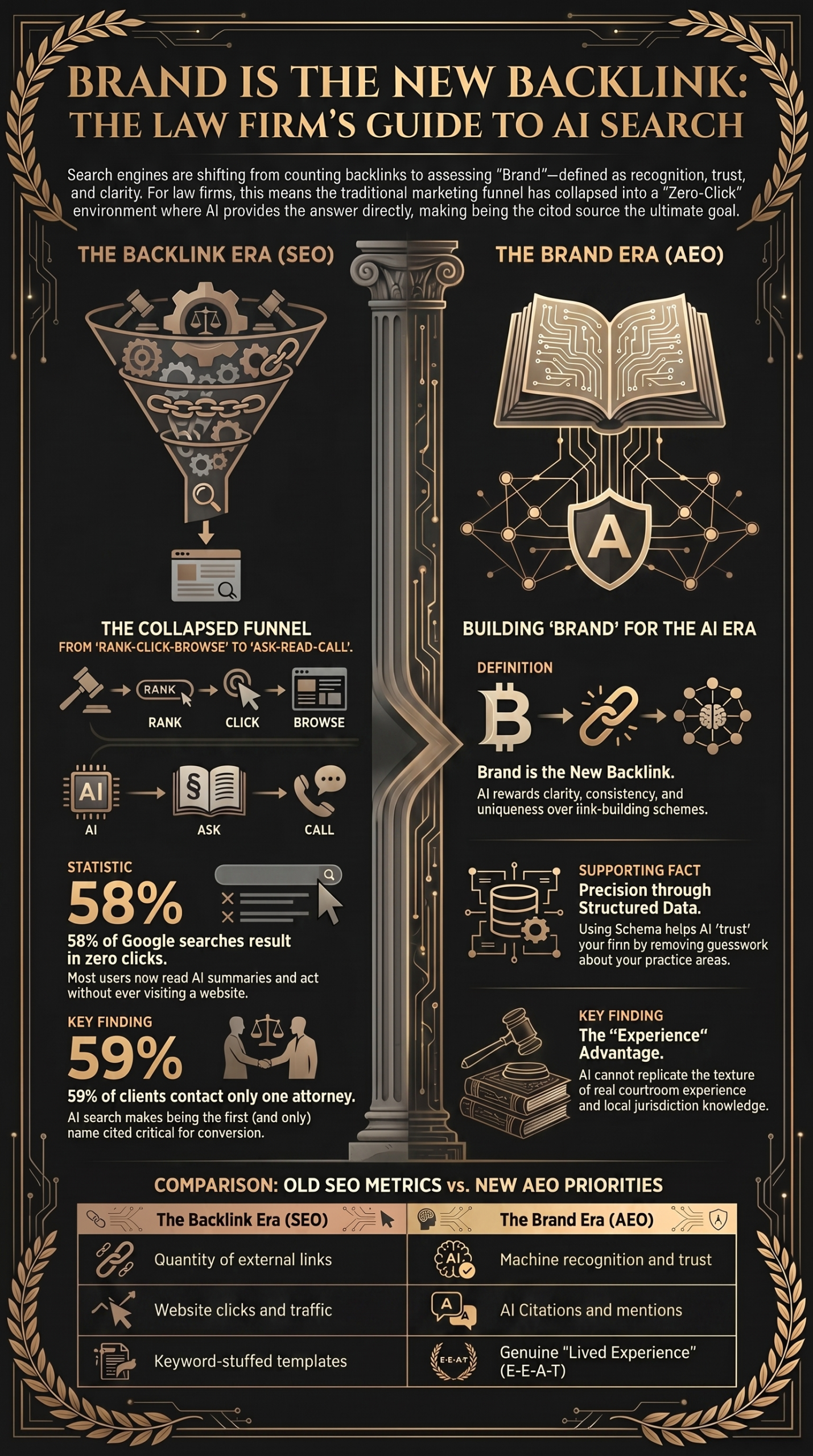
For two decades, the currency of search was the backlink. The more sites that pointed at yours, the more authority Google assigned you, and an entire industry grew up around accumulating those links by any means available. What the panel confirmed is that in AI search, the currency has changed. The engines are no longer just counting who points at you. They are assessing whether they recognize you, whether they understand you, and whether they trust you enough to say your name in an answer. That is what brand means in this context. Not a logo. Recognition, in the mind of a machine that millions of people now ask for advice.
Why the citation replaced the click
Cronin’s reasoning behind her line is the part every managing partner should sit with. Her point was that when the AI reads, synthesizes, and summarizes for the searcher, chasing clicks stops making sense, and the thing worth chasing becomes the citation, being the source the AI’s summary names and recommends.
The numbers behind that have been building for a while. A 2025 study from Semrush and Similarweb found that roughly 58 percent of Google searches in the United States now end without a click on any result. Pew Research reported in 2025 that only about 1 percent of users click a link inside a Google AI Overview. The other ninety nine read the summary and act on it. And legal clients act fast. FindLaw’s consumer research has found that most prospective clients contact only one attorney before deciding, about 59 percent in the 2024 survey. One summary, one name, one call.
So the funnel your firm was built on, rank, click, browse, call, has quietly collapsed into something shorter: ask, read, call. The only question that matters in that shorter funnel is whose name is in the answer. That is the citation Cronin was talking about, and it is the entire reason Answer Engine Optimization exists as a discipline. I wrote at length about that shift in why AEO is now the most important thing an attorney can do online, and this panel is the industry arriving at the same place.
Make your firm easy for a machine to understand
When the panel turned practical, the advice clustered around a single theme that I find myself repeating to firms every week. Make it easy for the AI to understand who you are, what you do, and why you are different. Alex Moss of Yoast put his emphasis on structured data, entities, and what he called data integrity, the idea that the less work an AI has to do to interpret your information, the less likely it is to get you wrong or leave you out.
This is the unglamorous machinery underneath everything I build. Schema and structured data tell the engines, in their own language, that you are a law firm, where you practice, which matters you handle, and which text on your page is a question and its answer. A firm without that layer is asking the machine to guess, and machines guess conservatively. They skip what they cannot confidently parse and they cite the competitor who labeled everything clearly.
The consistency half matters just as much. Smoljanovic Tucakov stressed that your positioning has to agree everywhere you appear, your website, your profiles, your directory listings, your mentions. For a law firm that means the same name, the same practice focus, the same locations, stated the same way across the whole web. When the signals agree, the machine becomes confident enough to name you. When your website says one thing, an old directory listing says another, and your Google Business Profile says a third, that confidence collapses, and an unconfident machine simply talks about someone else.
The experience advantage no AI can fake
The part of the panel I found most encouraging for attorneys was the discussion of experience. Cronin pointed to Google’s addition of the second E in E-E-A-T, experience alongside expertise, authoritativeness, and trust, and argued that most businesses misread it. Slapping an author biography on a page is not experience. Experience is firsthand observation, real matters, real outcomes, the texture of having actually done the work. Her conclusion, echoed across the panel, was that AI can generate content, but it cannot generate genuine personal experience, which makes lived experience one of the few signals a competitor cannot copy and a content mill cannot fake.
No profession is better positioned for that standard than law. You have tried the cases. You know what a Gwinnett County calendar call actually feels like, how a Tarrant County adjuster negotiates, what a Montgomery jury responds to. Most firm websites bury all of that under interchangeable copy that could belong to any firm in any city. The panelists were clear that generic, commodity content is exactly what these systems are learning to discount. The firms that win are the ones whose content could only have been written by someone who has done the work, which is why everything I build through Legal Articles and AI Content and AI Enhanced SEO and Content Strategy starts from your actual practice, your actual jurisdiction, and the actual law, not a template with a city name swapped in.
I will add my own version of that credential here, because it is the same principle. I came to this work after more than thirty years inside the NSA, FBI, DHS, and DoD, where precision and verification were the job itself. That background is not decoration on my site. It is the experience that shapes how I build, and it is exactly the kind of signal the panel was describing, the kind that cannot be manufactured.
There are no shortcuts, and that favors real firms
The panel was also blunt about the wave of tactics promising to game AI answers. Smoljanovic Tucakov’s advice was to stop hunting for tricks and invest in quality, product, and marketing as a whole. Cronin made an observation about Reddit that I think about often: its visibility in AI answers is not a loophole, it is the consequence of holding authentic human experience that the engines actively seek out. Cuesta noted that even brand focused PR with nofollow links, worthless under the old backlink arithmetic, is moving AI visibility, because the machine is measuring recognition, not link equity.
For attorneys, this is good news wearing a stern expression. The era when a competitor could out rank you by out spending you on link schemes is closing. What replaces it is a contest of legibility and substance, and substance is the one resource a genuine practice has that a marketing operation does not. But substance invisible to the machine still loses, which is why the work is to take what is real about your firm and make it unmistakable to the systems doing the recommending.
What this looks like in your market
Brand recognition in AI search is local. The machine is not deciding whether you are famous. It is deciding whether you are the trusted name for a specific question in a specific place, divorce in Marietta, a trucking wreck on I-45, a Camp Lejeune claim in Onslow County. That is why I build market by market rather than running one national campaign, and why each market gets content rooted in its own law and its own geography.
If you practice in one of the regions I serve, the regional hub shows how this whole system comes together where you are: Tampa Bay and Orlando in Florida, Houston and Dallas Fort Worth in Texas, Atlanta in Georgia, Montgomery in Alabama, Nashville in Tennessee, Charlotte, Raleigh, and Jacksonville and Camp Lejeune in North Carolina, and Columbus and Cleveland in Ohio.
And whichever market you are in, the honest starting point is the same. Find out whether the machines already recognize you. I run a Competitive AI Visibility Report that asks the engines the questions your clients ask and records exactly how often your firm is named, how often each competitor is named, and where the gaps are. It is the scoreboard for the contest the panel just described, and most firms have never seen theirs.
The window this opens, and how long it stays open
Here is the thing about moments like this panel. By the time the consensus is being said on stage, the early movers have already been building for a year or two, and the firms that move now still get to be early in their own market. Recognition compounds. Every accurate citation, every consistent signal, every piece of genuinely expert content makes the machine a little more confident about your firm, and confidence is sticky. The firm that becomes the default answer for car accident lawyer in its county does not get displaced by a competitor who shows up two years later with the same playbook. The position belongs to whoever claimed it first and kept it accurate.
So take the panel at its word. The backlink era rewarded whoever accumulated the most pointers. This era rewards whoever is the clearest, most consistent, most genuinely experienced name in their market, in the eyes of both a worried client and the machine that client asks first. That is a contest a real firm can win on the merits. My work is making sure the merits are visible.
Frequently asked questions
What does brand is the new backlink actually mean?
It means the currency of search visibility has shifted. Backlinks measured who pointed at your site, and accumulating them drove rankings. AI systems instead measure whether they recognize, understand, and trust your firm enough to name it in an answer. Recognition and trust, which is to say brand, now do the work backlinks used to do.
Does this mean backlinks and traditional SEO no longer matter for law firms?
No. The panel described AI optimization as a layer built on top of traditional SEO, not a replacement for it. Sound technical foundations, good content, and credible mentions still matter. What changed is the goal at the top, which is now the citation inside the answer rather than only the ranked link below it.
How does a law firm build brand recognition with AI systems?
Through consistency, structure, and substance. Your name, practice focus, and locations should agree everywhere you appear. Structured data should state plainly what your firm is and does. And your content should answer real client questions with the accuracy and firsthand experience only a practicing attorney has. Together those make your firm legible and trustworthy to the machine.
Why is firsthand experience so important for AI visibility?
Because it is the one signal that cannot be manufactured. AI systems are getting better at discounting generic, interchangeable content and rewarding material that reflects real work, real matters, and real outcomes. A firm’s lived experience in its courts and its community is content no competitor and no content mill can replicate.
Can a small firm compete with big advertisers under these rules?
Yes, and often more easily than under the old rules. AI answers do not reward ad budgets. They reward the clearest, most consistent, most genuinely expert source for a specific question in a specific place. A focused local firm with real substance and clean structure can be named ahead of a national advertiser, which was much harder in the backlink era.
How do I find out whether AI tools already recognize my firm?
Ask them the way your clients would, systematically, across the tools and the questions that matter in your market. A Competitive AI Visibility Report does exactly that, recording how often your firm and each competitor are named so you can see the scoreboard before deciding where to invest.