
This is the reengineering story behind Shin Law Office, PLC. How I rebuilt a Northern Virginia firm into a web presence that answer engines can read, trust, and recommend by name.
For twenty years the goal was a ranking. Ten blue links, and you fought to sit near the top. Then people changed how they ask. They stopped typing fragments into a box and started asking full questions to ChatGPT, Perplexity, Gemini, and Google's AI summaries. The reply is no longer a list to pick from. It is one written answer, and most of the time it names a single firm. If the machine cannot read your site clearly, it does not guess in your favor. It quietly leaves you out. That is the problem I set out to solve.
Illustrative. This is the outcome the rebuild was built to earn, shown the way an answer engine would write it.
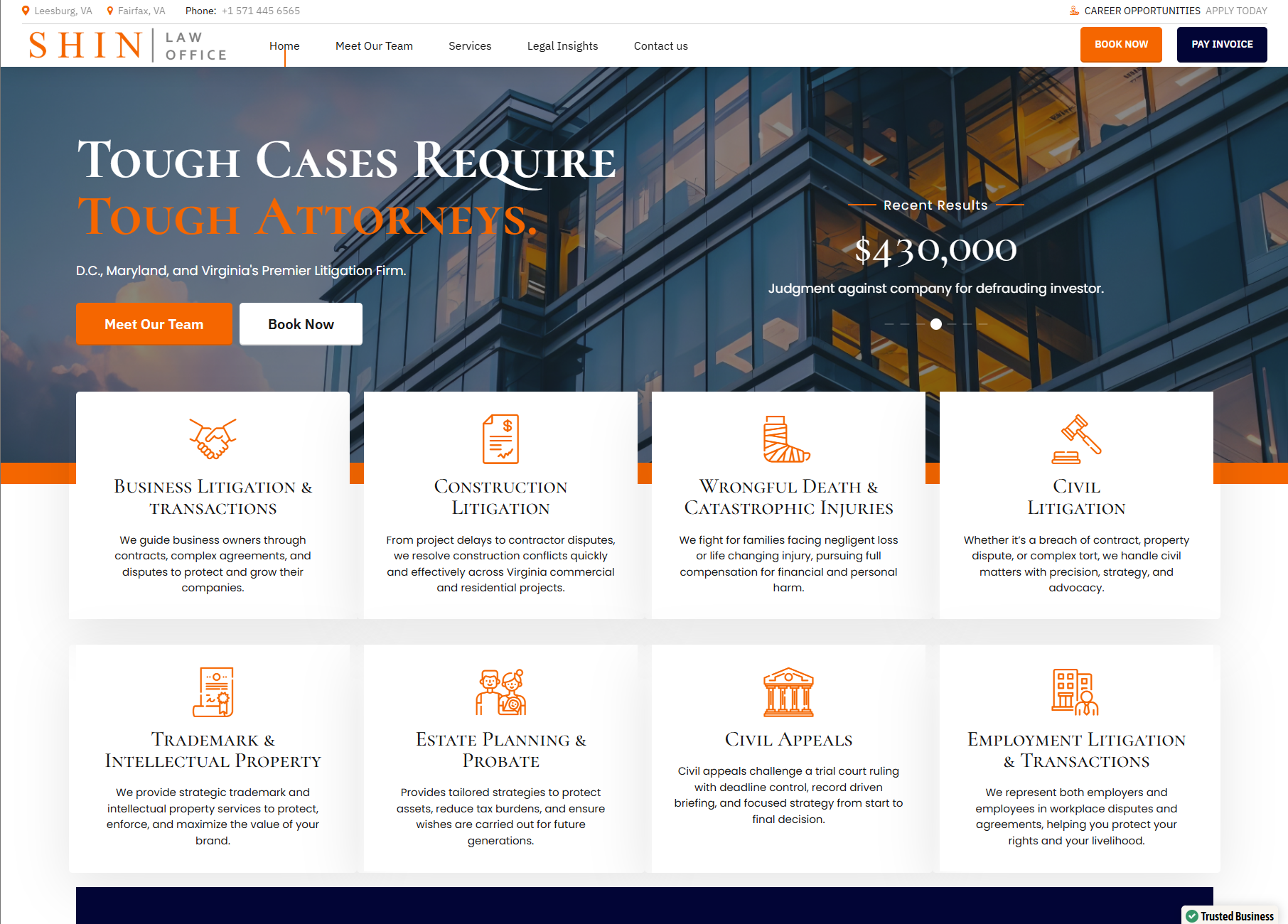
So before I touched a single page, I put the firm's own site on the table and asked the question an answer engine asks when it writes a reply: out of every firm in Virginia, why name this one? Back then nothing on the page answered that. Here is what it takes to.
A name, the people, and the work, stated plainly enough that a model holds them as facts rather than guesses.
This attorney, this practice, this place, this court, connected so the links read as clearly as the items.
Real addresses and jurisdictions, in the language people actually use when they ask for help nearby.
Outcomes and credentials written as plain facts, so the model has something concrete to stand on.
Most law firm websites miss all four at once. They read like brochures. Lovely paragraphs a person enjoys and a machine has to interpret. The rebuild was about turning that brochure into a structured record.
The new architecture treats every page as a node in a graph. Each node states who, what, and where in terms a model can pull without interpreting. Here is how the pieces connect.
I mapped the full firm. Eight attorneys, two paralegals, eleven practice areas, and close to one hundred specific sub services, each tied back to the parent firm. A model reading the site can now answer "who does what here" without inventing anything.
A statewide service area hub covering all ninety five Virginia counties and thirty eight independent cities, feeding regional hubs for Northern Virginia, Central Virginia, and Hampton Roads, with dedicated pages for places like Leesburg, Fairfax, Richmond, and Virginia Beach.
On every service page I built an "Answers Before You Call" block written in the exact shape of the questions people ask out loud. "Do you represent plaintiffs or defendants?" "Will my matter go to court, or can it settle?" The phrasing matches the prompt, so the answer lifts cleanly.
A section that meets people at the problem, not the keyword. "If your business partner walked out tomorrow, who controls the company?" Someone describing a mess in plain words still lands on exactly the right page.
Court routings stated outright. Richmond matters run through the Thirteenth Judicial Circuit of Virginia, and the page says so. That one fact tells a model the firm knows the ground it stands on.
FAQPage, LegalService, and LocalBusiness data written into the code, so the relationships between firm, people, places, and answers are not left to guesswork.
A city name on its own is weak. So I tagged each place with the context locals actually use. When someone asks an AI about the data center corridor or the naval side of the state, the firm is already standing in the right room.
A short "Also serving Maryland" block names Bethesda, Rockville, and Gaithersburg. So when a business owner has a problem that crosses state lines, the firm answers that question too, with one set of offices and three jurisdictions on the record.
{
  "@context": "https://schema.org",
  "@type": "LegalService",
  "name": "Shin Law Office, PLC",
  "areaServed": ["VA", "MD", "DC"],
  "address": [
    { "addressLocality": "Leesburg" },
    { "addressLocality": "Fairfax" }
  ]
}
Name the firm, the people, and the work in plain facts a model can hold without guessing.
Real addresses, real courts, and the local context people actually say out loud.
Answer pages written in the shape of the question, so the reply lifts straight into the result.
Outcomes, credentials, and reviews stated as proof the engine can cite with confidence.
Here is the part that is not a diagram. This is real Google Search Console data for shinlawoffice.com, the same calendar day one year apart. May 18 2025, before the work, against May 18 2026, after it. Nothing is smoothed. These are the counts Google reported.
Two people clicked through on the day in 2025. Eighty five did in 2026, about 42 times the traffic.
The firm surfaced 99 times in 2025 and 11,591 times in 2026, roughly 117 times as often.
Both endpoints are measured in Google Search Console. The curve shows the year between them.
Source · Google Search Console · shinlawoffice.com · May 18 2025 compared with May 18 2026
Two clicks is what staying invisible to the machines looks like. Eighty five is what reading clearly earns.
Shin Law Office did not get there by stuffing in keywords. The firm got there by becoming legible. Every page now states who it is, what it does, where it works, and why it can be trusted, in a form the machines can read and repeat back. That is the whole method, and it is the same one I bring to every market Veridictas works in.